Multi-client support operations
Your support team outgrew the patchwork of tools.
Most helpdesks handle tickets but not your people. Most workforce tools handle shifts and pay but not tickets. Run support for every client, and the team behind it, from one console.
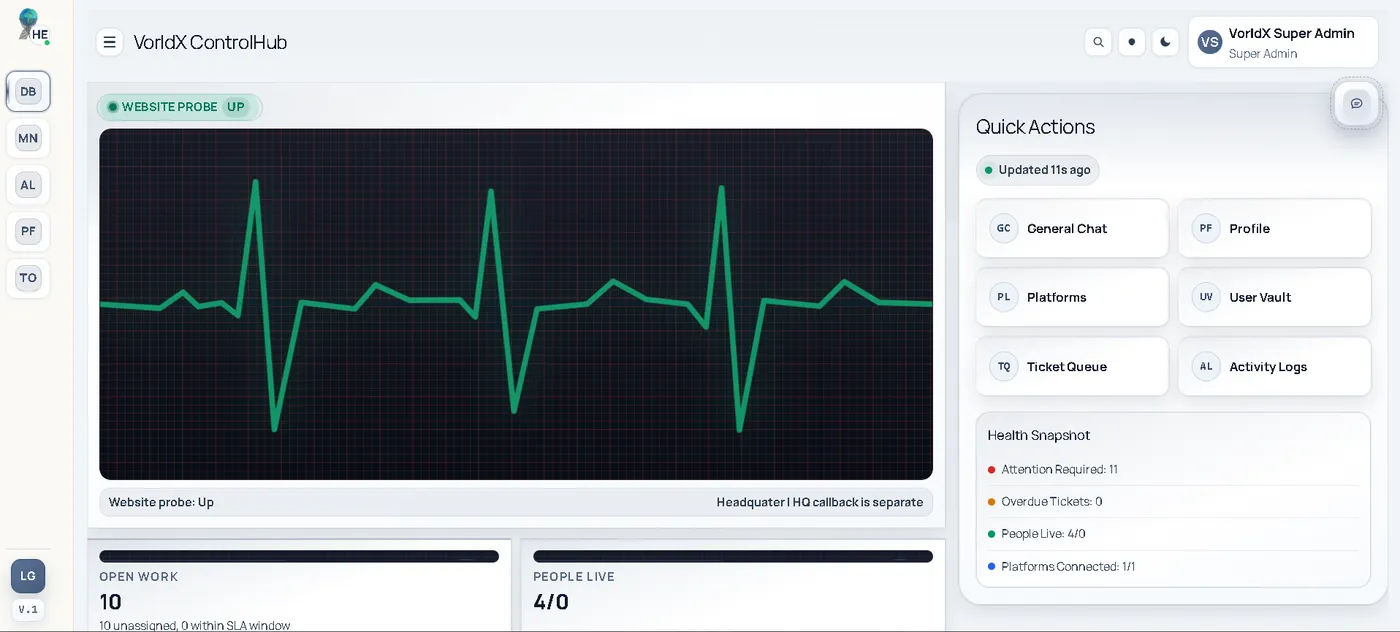
- 1system
- System for tickets, shifts and payroll, instead of three
- 2checks
- Checks on every request: the permission, and access to that client
- 0rows
- Rows of another client’s data a query can return
- 24/7watched
- Heartbeat and delivery tracking on every connected client site
An agency runs on four systems that do not talk to each other.
Every one of them holds part of the same operation, and none of them holds the whole of it. Reconciling them is someone’s week, every month.
How it works today
- A helpdesk for the tickets
- A roster somewhere else for the shifts
- Payroll in a third system
- Spreadsheets holding the clients together
With ControlHub
- Tickets from every client site
- Shifts, coverage and time logs
- Payroll built on those same hours
- One audit trail across all of it
Product proof
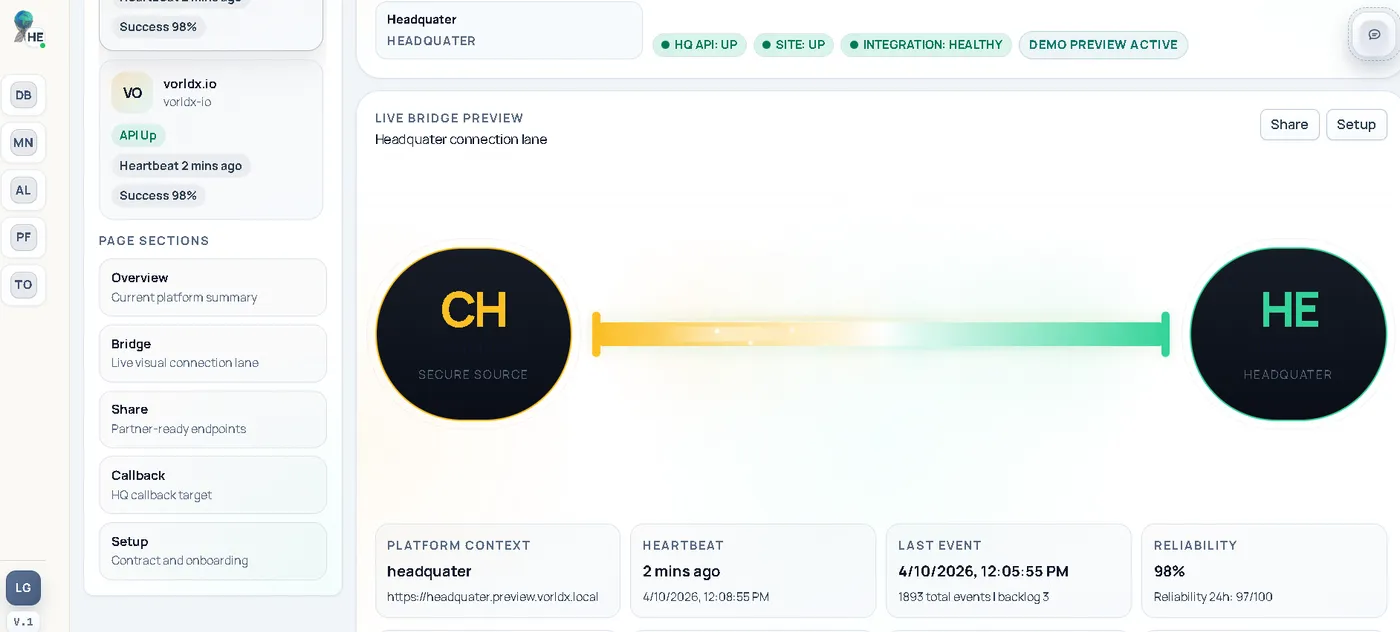
A client connects once. The work arrives where your team already works.
A live lane runs between each client platform and ControlHub. Tickets, heartbeats and delivery status are visible in one operational view, so a silent failure surfaces before the client reports it.
One operating system
Support operations without the patchwork.
Tickets, the people doing the work, and the client boundary around both belong in the same system.
Every client on one console
A client site connects once. After that its tickets arrive in their own queue automatically, with heartbeats and delivery tracked on every lane. No forwarding rules, no shared inbox, no copy-paste.
The team, not just the tickets
Shifts, coverage teams and time logs sit in the same system as the work. Pay periods build on the hours your people actually worked, with overtime and deductions applied and every payout batch approved and recorded.
Access that matches the assignment
An agent sees the clients they are assigned to and nothing else. Permission alone is never enough — access to that specific client has to be granted as well, and both are checked on every request.
An agency runs on a loop, not a list.
The volume arriving decides the coverage you schedule. The coverage decides the hours worked. The hours decide what you pay. Today that loop runs across four systems, and it is the joins between them that leak.
Volume arrives
Tickets arrive from every connected client site.
Coverage is planned
Shifts and coverage teams are set against that volume.
Work is done
Agents work the queues they hold access to.
Hours are recorded
Time logs record the hours actually worked.
Payroll runs
Pay periods build on those same hours, then are approved.
The owner sees it
What it cost, and where it went, against every client.
Client separation
Your clients will ask how their data stays separate.
Most answers are policy — restricted access, trained staff, good intentions. Ours is structural. Each client’s records are isolated inside the database itself, so a query for another client’s data comes back empty.
Permission alone is never enough: an agent must also hold access to that specific client, and both are checked on every request. It is an answer that survives a security review — the one your own clients put you through.
When a ticket turns out to be a real bug.
Developers get the proof, not the complaint. Available on the Review Bridge plan and above, and switched on for the length of your trial.
Escalated
An agent raises it with what the customer reported.
Investigated
It is reproduced, with logs and screenshots attached.
Verified
Evidence is checked before it goes any further.
Handed over
Engineering receives a confirmed bug, not a guess.
Larger operations, on your terms
Past twenty-five people or three client sites, capacity is set by contract rather than a plan. Optional capabilities can be enabled per agreement.
Run the whole operation from one place.
Tell us how your agency runs support today and we will size a workspace against it, then connect your first client site with you.